Verbal Reasoning - Syllogism - Discussion
Discussion Forum : Syllogism - Syllogism 1 (Q.No. 2)
Directions to Solve
In each of the following questions two statements are given and these statements are followed by two conclusions numbered (1) and (2). You have to take the given two statements to be true even if they seem to be at variance from commonly known facts. Read the conclusions and then decide which of the given conclusions logically follows from the two given statements, disregarding commonly known facts.
Give answer:
- (A) If only (1) conclusion follows
- (B) If only (2) conclusion follows
- (C) If either (1) or (2) follows
- (D) If neither (1) nor (2) follows and
- (E) If both (1) and (2) follow.
2.
Statements: All the harmoniums are instruments. All the instruments are flutes.
Conclusions:
- All the flutes are instruments.
- All the harmoniums are flutes.
Answer: Option
Explanation:
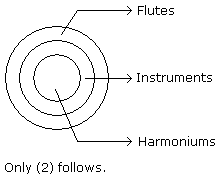
Discussion:
74 comments Page 5 of 8.
Avinash said:
1 decade ago
I just can't get the logic behind these kind of questions. Can anyone please help me with the simplest logic ?
Manoj kumar said:
1 decade ago
Raval's notation is new simplest and quickest way to solve syllogism problems at a glance. Search 'raval notations at philpapers' in google and find complete new and simple approach published at University of London.
Jayesh said:
1 decade ago
Answer will be (b)
Since it is satisfying all five rules of syllogism
1)A syllogism must contain exactly three terms, each of which is used in the same sense.
2)The middle term must be distributed in at least one premise.
3) If MAJOR or MINOR term is distributed in the conclusion, then it must be distributed in the premises.
4) No syllogism can have two negative premises.
5) If either premise is negative, the conclusion must be negative.
Since it is satisfying all five rules of syllogism
1)A syllogism must contain exactly three terms, each of which is used in the same sense.
2)The middle term must be distributed in at least one premise.
3) If MAJOR or MINOR term is distributed in the conclusion, then it must be distributed in the premises.
4) No syllogism can have two negative premises.
5) If either premise is negative, the conclusion must be negative.
Rupa said:
1 decade ago
I think answer is E. Can any one explain how statement1 dosen't follows?
Manoj kumar said:
1 decade ago
Raval's notation is new simplest and quickest way to solve syllogism problems at a glance.Very soon you will find that everyone is applying Raval's method for syllogism problems.
Sravanthi said:
1 decade ago
I didn't understand ravinder kumar answer. Could you pleas explain that ?
Neeta said:
1 decade ago
Please explain rules of Raval notations.
Trisaiteja said:
1 decade ago
Don't follow mathematical rules just follow the rules of the syllogism.
Kruthika said:
1 decade ago
Can anyone tell me about that diagram drawn under solution ?
Gokila said:
1 decade ago
Very good explanation prachi;-).
Post your comments here:
Quick links
Quantitative Aptitude
Verbal (English)
Reasoning
Programming
Interview
Placement Papers