Verbal Reasoning - Syllogism - Discussion
Discussion Forum : Syllogism - Syllogism 1 (Q.No. 10)
Directions to Solve
In each of the following questions two statements are given and these statements are followed by two conclusions numbered (1) and (2). You have to take the given two statements to be true even if they seem to be at variance from commonly known facts. Read the conclusions and then decide which of the given conclusions logically follows from the two given statements, disregarding commonly known facts.
Give answer:
- (A) If only (1) conclusion follows
- (B) If only (2) conclusion follows
- (C) If either (1) or (2) follows
- (D) If neither (1) nor (2) follows and
- (E) If both (1) and (2) follow.
10.
Statements: All the pencils are pens. All the pens are inks.
Conclusions:
- All the pencils are inks.
- Some inks are pencils.
Answer: Option
Explanation:
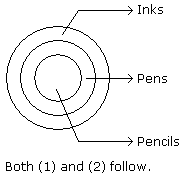
Discussion:
24 comments Page 2 of 3.
Sruthi said:
1 decade ago
How second statement comes true?
Khusi said:
6 years ago
How both statements comes true? Please explain to me.
Gopal singh said:
9 years ago
If all the pencil are inkes then some inkes are pencil.
Krishna said:
10 years ago
When we choose 'either option'? Explain with an example.
Jitendra maurya said:
1 decade ago
Both sentence are universal affirmation hence conclusion must be universal affirmation and it should not include common term (pens). Hence conclusion first is right it again.
If all the pencils are inks then we can also conclude that some inks are pencil because sentence is not saying that all inks is pencil. Hence second also follow.
If all the pencils are inks then we can also conclude that some inks are pencil because sentence is not saying that all inks is pencil. Hence second also follow.
Kavi said:
2 decades ago
how second statement comes true???
Please explain me..
Please explain me..
Anu said:
1 decade ago
How is the second statement true? Can someone please explain it in an easy way?
Rishi said:
1 decade ago
The right answer is A.
All+All=All.
All+All=All.
Vignesh said:
1 decade ago
All the pencils are inks.
Some inks are pencils.
Why don't we take as either case? I mean either 1 or 2.
Some inks are pencils.
Why don't we take as either case? I mean either 1 or 2.
Siddhesh said:
1 decade ago
Hello I don't understood how the second statement are true because we can't draw the solution because it may or may not be says that some inks are pencil. So please explain it, how it is true?
Post your comments here:
Quick links
Quantitative Aptitude
Verbal (English)
Reasoning
Programming
Interview
Placement Papers