Verbal Reasoning - Syllogism - Discussion
Discussion Forum : Syllogism - Syllogism 1 (Q.No. 2)
Directions to Solve
In each of the following questions two statements are given and these statements are followed by two conclusions numbered (1) and (2). You have to take the given two statements to be true even if they seem to be at variance from commonly known facts. Read the conclusions and then decide which of the given conclusions logically follows from the two given statements, disregarding commonly known facts.
Give answer:
- (A) If only (1) conclusion follows
- (B) If only (2) conclusion follows
- (C) If either (1) or (2) follows
- (D) If neither (1) nor (2) follows and
- (E) If both (1) and (2) follow.
2.
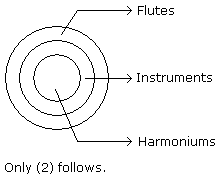
Statements: All the harmoniums are instruments. All the instruments are flutes.
Conclusions:
- All the flutes are instruments.
- All the harmoniums are flutes.
Answer: Option
Explanation:
Discussion:
74 comments Page 7 of 8.
Akshit said:
1 decade ago
Let flutes be x, harmonium be y and instruments be z.
Therefore all y = z, all z = x.
Hence, all the harmoniums are flutes.
Therefore all y = z, all z = x.
Hence, all the harmoniums are flutes.
Kachwal Jyothi sharma said:
1 decade ago
There are some conditions in syllogism.
For ALL = 100, 50.
SOME = 50, 50.
NO = 100, 100.
In conclusion the weight cannot be increased than statement, it can be decreased but cannot be increased, So conclusion 1 is wrong.
And one more to be remember if statement consist +ve, +ve then conclusion must be +ve.
If statement consist +ve, -ve then conclusion must be -ve. If statement consist -ve, -ve then No conclusion.
For ALL = 100, 50.
SOME = 50, 50.
NO = 100, 100.
In conclusion the weight cannot be increased than statement, it can be decreased but cannot be increased, So conclusion 1 is wrong.
And one more to be remember if statement consist +ve, +ve then conclusion must be +ve.
If statement consist +ve, -ve then conclusion must be -ve. If statement consist -ve, -ve then No conclusion.
Jacky said:
1 decade ago
@Prachi your second part is wrong I guess. As you have taken harmonium as z n flutes as x. Therefore z=x. Not all y= all z.
As per the second part. If my concept is wrong then please explain it to me.
As per the second part. If my concept is wrong then please explain it to me.
Ravinder Kumar said:
1 decade ago
Hello @Vinoth.
Here it is not possible to explain Raval notations due to space restrictions. You may search for Raval notations at google.
Here it is not possible to explain Raval notations due to space restrictions. You may search for Raval notations at google.
Vinoth said:
1 decade ago
Hi @Mr. Ravinder kumar/@Mr. Jayesh.
Could you please explain the raval notations in detail?
It will be very helpful to me. Thanks in advance.
Could you please explain the raval notations in detail?
It will be very helpful to me. Thanks in advance.
Parth said:
2 decades ago
Can anyone please explain me this question? I didn't get.
Uday S said:
1 decade ago
Excellent explanation @Prachi, you are right. Its very simple as if A=B, B=C.
Then C should always be equal to A, and applying same concept here there are flutes which are not harmoniums but all harmoniums are flutes for true.
Then C should always be equal to A, and applying same concept here there are flutes which are not harmoniums but all harmoniums are flutes for true.
Ram said:
1 decade ago
See inner (means down to up) to outer all + some both are follows. But outer (means up to down) only follows some.
Ravinder kumar said:
1 decade ago
Go through transformed raval notations and you will solve syllogism problems at a glance without any paperwork.
Raval notations is a latest method to solve syllogism problems at a glance, say 5-7 seconds.
Raval notations is a latest method to solve syllogism problems at a glance, say 5-7 seconds.
Sonia said:
1 decade ago
Can anybody tell me the trick to solve syllogism.
Post your comments here:
Quick links
Quantitative Aptitude
Verbal (English)
Reasoning
Programming
Interview
Placement Papers