Verbal Reasoning - Syllogism - Discussion
Discussion Forum : Syllogism - Syllogism 1 (Q.No. 2)
Directions to Solve
In each of the following questions two statements are given and these statements are followed by two conclusions numbered (1) and (2). You have to take the given two statements to be true even if they seem to be at variance from commonly known facts. Read the conclusions and then decide which of the given conclusions logically follows from the two given statements, disregarding commonly known facts.
Give answer:
- (A) If only (1) conclusion follows
- (B) If only (2) conclusion follows
- (C) If either (1) or (2) follows
- (D) If neither (1) nor (2) follows and
- (E) If both (1) and (2) follow.
2.
Statements: All the harmoniums are instruments. All the instruments are flutes.
Conclusions:
- All the flutes are instruments.
- All the harmoniums are flutes.
Answer: Option
Explanation:
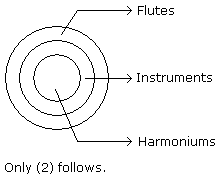
Discussion:
74 comments Page 4 of 8.
Haider said:
10 years ago
@Prachi.
Your solving method is very fantastic. Thanks.
If you have any shortcut method for setting arrangement.
Please help me.
Your solving method is very fantastic. Thanks.
If you have any shortcut method for setting arrangement.
Please help me.
Munnangi.devi said:
10 years ago
Why not it is D? I assure it is option D.
Salil said:
10 years ago
What is the numbering (i.e 100 50) for SOME NOT?
RACHANA said:
1 decade ago
The answer is option D.
Venkatesh said:
1 decade ago
As per my knowledge, my answer is E. Can you please explain how it is wrong?
Diya said:
1 decade ago
Even I have a doubt why it is not conclusion one?
Ashish said:
1 decade ago
Even I also found the answer to be (d).
Najmul haque said:
1 decade ago
Answer should be d.
All the harmonium= all the instrument.
All the instrument = all the flute.
So both the statement is true.
All the flutes are instruments.
All the harmoniums are flutes.
All the harmonium= all the instrument.
All the instrument = all the flute.
So both the statement is true.
All the flutes are instruments.
All the harmoniums are flutes.
Parvathy said:
1 decade ago
A statement can convert into A2 statement to S2 statement. So can convert into all flutes are harmoniums.
Then both 1 and 2 follows.
Then both 1 and 2 follows.
Sai Teja said:
1 decade ago
Hi friends.
Can you explain the short cut in syllogism?
Can you explain the short cut in syllogism?
Post your comments here:
Quick links
Quantitative Aptitude
Verbal (English)
Reasoning
Programming
Interview
Placement Papers