Online Engineering Mechanics Test - Engineering Mechanics Test - Random
- This is a FREE online test. Beware of scammers who ask for money to attend this test.
- Total number of questions: 20.
- Time allotted: 30 minutes.
- Each question carries 1 mark; there are no negative marks.
- DO NOT refresh the page.
- All the best!
Marks : 2/20
Test Review : View answers and explanation for this test.
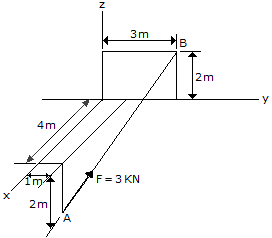
Express force F as a Cartesian vector; then determine its direction angles.
 = 48.2°,
  = 70.5°,
  = 48.2° = 131.8°, = 70.5°, = 48.2° = 48.2°, = 70.5°, = 48.2° = 131.8°, = 70.5°, = 48.2°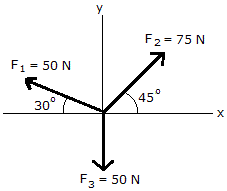
Determine the magnitude of the resultant force by adding the rectangular components of the three forces.
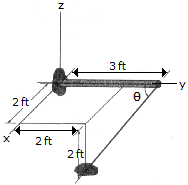
Determine the angle  between the pole AC and the wire AB.
= 131.8° = 70.5° = 109.5° = 48.2°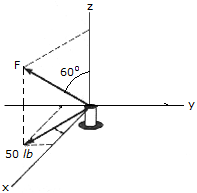
Force F acts on peg A such that one of its components, lying in the x-y plane, has a magnitude of 50 lb. Express F as a Cartesian vector.

Cable BC exerts a force of F = 28 N on the top of the flagpole. Determine the projection of this force along the positive z axis of the pole.
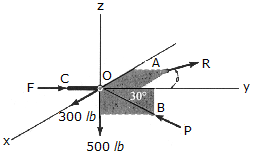
The joint O of a space frame is subjected to four forces. Strut OA lies in the x-y plane and strut OB lies in the y-z plane. Determine the force acting in each if the three struts required for equilibrium of the joint. Set = 45°.
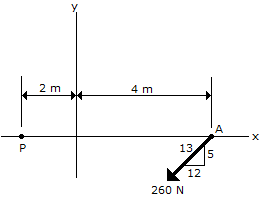
Determine the magnitude and direction of the moment of the force of the movement if the force at A about point P.


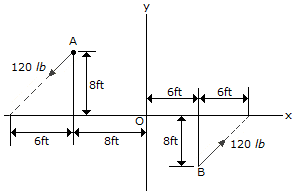
Determine the magnitude and direction of the couple moment.
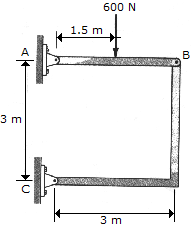
Determine the horizontal and vertical components of force at pins A and C of the two-member frame.
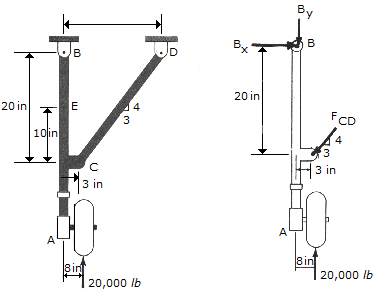
Determine the internal axial force, shear force, and moment at point E of the oleo strut AB of the aircraft landing gear.
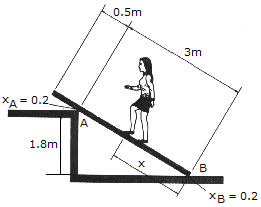
A uniform beam has a mass of 18 kg and rests on two surfaces at points A and B. Determine the maximum distance x to which the girl can slowly walk up the beam before it begins to slip. The girl has a mass of 50 kg and walks up the beam with a constant velocity.
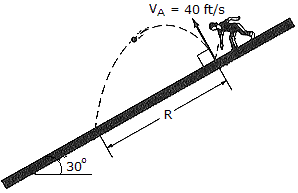
A ball is thrown downward on the 30° inclined plane so that when it rebounds perpendicular to the incline it has a velocity of vA = 40 ft/s. Determine the distance R where it strikes the plane at B.
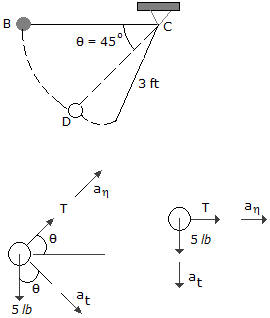
The pendulum bob B has a weight of 5 lb and is released from rest in the position shown, =0°. Determine the tension in string BC just after the bob is released, = 0°, and also at the instant the bob reaches point D, = 45°.
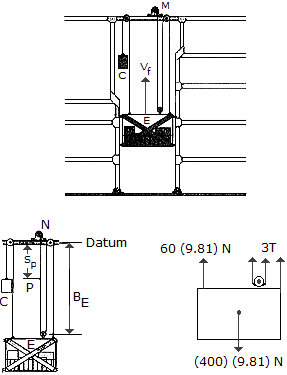
The elevator E and its freight have a total mass of 400 kg. Hoisting is provided by the motor M and the 60-kg block C. If the motor has an efficiency of e = 0.6, determine the power that must be supplied to the motor when the elevator is hoisted upward at a constant speed of vE = m/s.
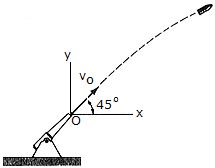
The projectile having a mass of m = 3 kg is fired from a cannon with a muzzle velocity of vO = 500 m/s. Determine the projectile's angular momentum about point O at the instant it is at the maximum height of its trajectory.
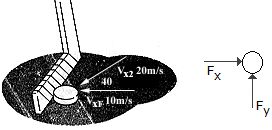
A hockey puck is traveling to the left with a velocity of v1 = 10 m/s when it is struck by a hockey stick and given a velocity of v2 = 20 m/s as shown. Determine the magnitude of the net impulse exerted by the hockey stick on the puck. The puck has a mass of 0.2 kg.
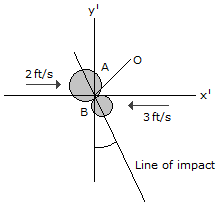
Two coins A and B have the initial velocities shown just before they collide at point O. If they have weights of WA = 13.2(10-3) lb and WB = 6.6(10-3) lb and the surface upon which they slide is smooth, determine their speed just after impact. The coefficient of restitution is e = 0.65.
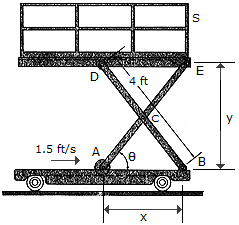
The scaffold S is raised hydraulically by moving the roller at A towards the pin at B. If A is approaching B with a speed of 1.5 ft/s, determine the speed at which the platform is rising as a function of . Each link is pin-connected at its midpoint and end points and has a length of 4 ft.
ft/s ft/s ft/s ft/s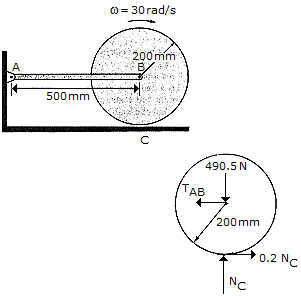
The 50-kg cylinder has an angular velocity of 30 rad/s when it is brought into contact with the horizontal surface at C. If the coefficient of friction is  c = 0.2, determine how long it takes for the cylinder to stop spinning. What force is developed at the pin A during this time? The axis of the cylinder is connected to two symmetrical links. (Only AB is shown.) For the computation, neglect the weight of the links.
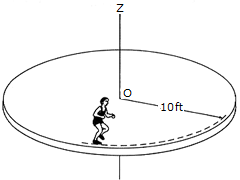
A horizontal circular platform has a weight of 300 lb and a radius of gyration about the z axis passing through its center O of kz = 8 ft. The platform is free to rotate about the z axis and is initially at rest. A man, having a weight of 150 lb, begins to run along the edge in a circular path of radius 10 ft. If he has a speed of 4 ft/s and maintains this speed relative to the platform, compute the angular velocity of the platform.
 = 0.313 rad/s = 0.1754 rad/s = 0.225 rad/s = 1.429 rad/s