Online Verbal Reasoning Test - Verbal Reasoning Test 10
- This is a FREE online test. Beware of scammers who ask for money to attend this test.
- Total number of questions: 20.
- Time allotted: 30 minutes.
- Each question carries 1 mark; there are no negative marks.
- DO NOT refresh the page.
- All the best!
Marks : 2/20
Test Review : View answers and explanation for this test.

Q - P → Q is the mother of P
P + R → R is the brother of P
Hence, → q is the mother of R
R % T → R is the father of T.
Hence, Q is the grandmother of T.
A $ B → A is the brother of B
B * C → B is the son of C
Hence, → A is the son of C
C @ D → C is the wife of D
Hence, → C is the mother of A.
In each of the following questions two statements are given and these statements are followed by two conclusions numbered (1) and (2). You have to take the given two statements to be true even if they seem to be at variance from commonly known facts. Read the conclusions and then decide which of the given conclusions logically follows from the two given statements, disregarding commonly known facts.
Give answer:
- (A) If only (1) conclusion follows
- (B) If only (2) conclusion follows
- (C) If either (1) or (2) follows
- (D) If neither (1) nor (2) follows and
- (E) If both (1) and (2) follow.
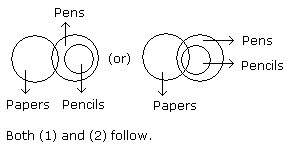
Statements: Some papers are pens. All the pencils are pens.
Conclusions:
- Some pens are pencils.
- Some pens are papers.
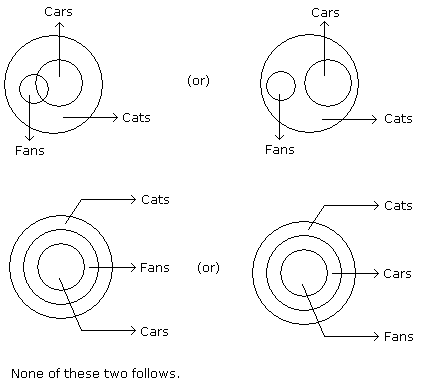
Statements: All cars are cats. All fans are cats.
Conclusions:
- All cars are fans.
- Some fans are cars.
Statements: All the papers are books. All the bags are books. Some purses are bags.
Conclusions:
- Some papers are bags.
- Some books are papers.
- Some books are purses.

Two positions of a dice are shown below. When number '1' is on the top. What number will be at the bottom?

Here 4 positions of a cube are shown. Which sign will be opposite to '+' ?


The following questions are based on the information given below:
- There is a cuboid whose dimensions are 4 x 3 x 3 cm.
- The opposite faces of dimensions 4 x 3 are coloured yellow.
- The opposite faces of other dimensions 4 x 3 are coloured red.
- The opposite faces of dimensions 3 x 3 are coloured green.
- Now the cuboid is cut into small cubes of side 1 cm.

Number of small cubes having only one face coloured = 2 x 2 + 2 x 2 + 2 x 1
= 4 + 4 + 2
= 10

There is no such cube in all, where all the faces are unclosured.

- P is second to the right of T who is the neighbour of R and V.
- S is not the neighbour of P.
- V is the neighbour of U.
- Q is not between S and W. W is not between U and S.

Which one will replace the question mark ?

(4 + 8) x 9 = 108
(5 + 4) x 12 = 108.
Which one will replace the question mark ?

(0 + 2 + 6 + 4) - 2 = 10
and (6 + 2 + 10 + 8) - 2 = 24
Therefore, (4 + 14 + 12 + 10) - 2 = 38.
Which one will replace the question mark ?

(16 + 13) = (14 + 15)
and (28 + 12) = (10 + 30)
Therefore (29 + 16) = (15 + 30).
Which one will replace the question mark ?

(2)3 + (1)3 + (3)3 = 36
and (0)3 + (4)3 + (3)3 = 91
Therefore, (4)3 + (2)3 + (1)3 = 73.
Which one will replace the question mark ?

1 + 2 + 3 + 4 = 10
and 1 + 3 + 5 + 8 = 17
Similarly, 1 + 4 + 6 + 9 = 20.