Verbal Reasoning - Syllogism - Discussion
Discussion Forum : Syllogism - Syllogism 1 (Q.No. 9)
Directions to Solve
In each of the following questions two statements are given and these statements are followed by two conclusions numbered (1) and (2). You have to take the given two statements to be true even if they seem to be at variance from commonly known facts. Read the conclusions and then decide which of the given conclusions logically follows from the two given statements, disregarding commonly known facts.
Give answer:
- (A) If only (1) conclusion follows
- (B) If only (2) conclusion follows
- (C) If either (1) or (2) follows
- (D) If neither (1) nor (2) follows and
- (E) If both (1) and (2) follow.
9.
Statements: Some cows are crows. Some crows are elephants.
Conclusions:
- Some cows are elephants.
- All crows are elephants.
Answer: Option
Explanation:
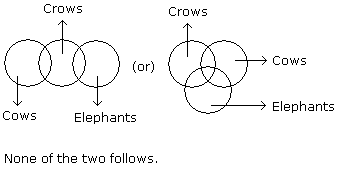
Discussion:
150 comments Page 6 of 15.
Ana said:
9 years ago
Can someone tell me what is the correct answer?
Vivek said:
9 years ago
I agree with @Sumit.
The second diagram should only be considered when possibilities are mentioned in the conclusion. D is the Correct Answer.
The second diagram should only be considered when possibilities are mentioned in the conclusion. D is the Correct Answer.
Naveen said:
9 years ago
Finally what you people are saying. If possibility is there we consider it or not. ?
Sagnik Banerjee said:
9 years ago
Option A is correct. We just need one venn diagram which satisfies the given option. So according to 2nd venn option A is correct.
Hari said:
9 years ago
A is the correct answer.
Abhinav said:
9 years ago
But we can't ignore the fact that we don't have to suppose the things out of the statement.
Rajat jain said:
9 years ago
I also think option A is correct. Many of qus in syllogism is based on possibilities. So, we can't ignoer 2nd option.
Manoj said:
9 years ago
Please clarify it @Raghavendra.
Priyatosh Dhara said:
9 years ago
According to me, A is the right option. We have to consider least possibilities.
Umrah said:
9 years ago
It is quit confusing when to consider the possibilities! Please, someone help me.
Post your comments here:
Quick links
Quantitative Aptitude
Verbal (English)
Reasoning
Programming
Interview
Placement Papers