Verbal Reasoning - Syllogism - Discussion
Discussion Forum : Syllogism - Syllogism 1 (Q.No. 5)
Directions to Solve
In each of the following questions two statements are given and these statements are followed by two conclusions numbered (1) and (2). You have to take the given two statements to be true even if they seem to be at variance from commonly known facts. Read the conclusions and then decide which of the given conclusions logically follows from the two given statements, disregarding commonly known facts.
Give answer:
- (A) If only (1) conclusion follows
- (B) If only (2) conclusion follows
- (C) If either (1) or (2) follows
- (D) If neither (1) nor (2) follows and
- (E) If both (1) and (2) follow.
5.
Statements: Some papers are pens. All the pencils are pens.
Conclusions:
- Some pens are pencils.
- Some pens are papers.
Answer: Option
Explanation:
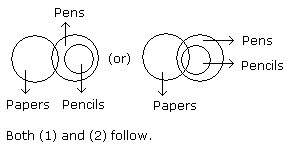
Discussion:
65 comments Page 5 of 7.
Shruthi said:
1 decade ago
can anyone tell the correct answer ?
Kushal said:
1 decade ago
I think only CONCLUSION II follows . Can anyone elaborate the explanation
Rajesh NRIIT said:
1 decade ago
Both the conclusions cannot follow because the middle term pens not distributed at least once in the premises and another one is conclusions does not contain middle term.
Arti said:
1 decade ago
By the rule of conversion 'some papers are pens' can be written as 'some pens are papers'. So conclusion (2) is correct. Now 'all the pencils are pens' can be written as 'some pencils are pens' that again written as 'some pens are pencils'. So conclusion (1) is also correct. So the answer is (e).
LoveGod said:
1 decade ago
I do not see how either conclusions are valid since the middle term is found only in one premise.
Narendra said:
1 decade ago
None of the conclusions follow as they don't fall in the 24 valid cases.
Devendra said:
1 decade ago
Option D will be correct why because middle term in both cases are not distributed, at least in one premises it should be distributed.
Mou said:
1 decade ago
The answer should be D since the middle term is not distributed.
Abdul said:
1 decade ago
Since the "Middle Term" of the given two statements is not distributed. Hence Neither of the conclusion follows.
(or)
Clearly, since both premises are particular, no conclusion follows.
Condition: The Middle Term (M) should be distributed at least once in the premises, the conclusion cannot follow.
Condition: If both premises are particular, no conclusion follows.
(or)
Clearly, since both premises are particular, no conclusion follows.
Condition: The Middle Term (M) should be distributed at least once in the premises, the conclusion cannot follow.
Condition: If both premises are particular, no conclusion follows.
Ashu said:
1 decade ago
Answer should be D. As middle term is not distributed.
Post your comments here:
Quick links
Quantitative Aptitude
Verbal (English)
Reasoning
Programming
Interview
Placement Papers