Electronics and Communication Engineering - Electromagnetic Field Theory
Exercise : Electromagnetic Field Theory - Section 9
- Electromagnetic Field Theory - Section 1
- Electromagnetic Field Theory - Section 2
- Electromagnetic Field Theory - Section 3
- Electromagnetic Field Theory - Section 4
- Electromagnetic Field Theory - Section 5
- Electromagnetic Field Theory - Section 6
- Electromagnetic Field Theory - Section 7
- Electromagnetic Field Theory - Section 8
- Electromagnetic Field Theory - Section 9
- Electromagnetic Field Theory - Section 10
- Electromagnetic Field Theory - Section 11
- Electromagnetic Field Theory - Section 12
- Electromagnetic Field Theory - Section 13
- Electromagnetic Field Theory - Section 14
- Electromagnetic Field Theory - Section 15
- Electromagnetic Field Theory - Section 16
36.
If the atomic number of germanium is 32, the number of electrons in the outer most shell will be
37.
Dielectric loss due to polarisation occurs in
38.
A metal loses electrons at room temperature.
39.
Figure shows small signal common base transistor circuit.The current source I and resistor R on the output side are
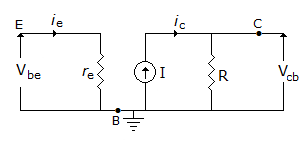
 ie and re ie and (1 - a)re
(1 - a)ie and (1 - a)re
a ie and re
40.
Consider the following statement associated with bipolar junction transistor and JFET
- The former has higher input impedance than the later
- The former has higher frequency stability than the later
- The later has lower noise figure than the former
- The later has higher power rating than the former.
Quick links
Quantitative Aptitude
Verbal (English)
Reasoning
Programming
Interview
Placement Papers