Verbal Reasoning - Syllogism - Discussion
Discussion Forum : Syllogism - Syllogism 1 (Q.No. 1)
Directions to Solve
In each of the following questions two statements are given and these statements are followed by two conclusions numbered (1) and (2). You have to take the given two statements to be true even if they seem to be at variance from commonly known facts. Read the conclusions and then decide which of the given conclusions logically follows from the two given statements, disregarding commonly known facts.
Give answer:
- (A) If only (1) conclusion follows
- (B) If only (2) conclusion follows
- (C) If either (1) or (2) follows
- (D) If neither (1) nor (2) follows and
- (E) If both (1) and (2) follow.
1.
Statements: Some actors are singers. All the singers are dancers.
Conclusions:
- Some actors are dancers.
- No singer is actor.
Answer: Option
Explanation:
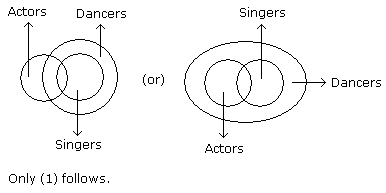
Discussion:
78 comments Page 6 of 8.
Kumar Sourabh said:
1 decade ago
I want to know these 2 crucial facts about syllogism: First, we all know that 'No and Some'/'Some and some not' form an either case or a complimentary pair, but does 'All and No' form a complimentary pair...Second, what is the difference in approach of these two statements:
1.All stones are glass.
2.All stones being glass is a possibility.
1.All stones are glass.
2.All stones being glass is a possibility.
Suganya said:
1 decade ago
In second diagram its shown all actors are dancer.
In first some actor are dancer.
If both possibility are true then only conclusion occurs.
So neither 1 nor 2 should be the answer.
Why conclusion I is selected?
In first some actor are dancer.
If both possibility are true then only conclusion occurs.
So neither 1 nor 2 should be the answer.
Why conclusion I is selected?
Rajni said:
1 decade ago
@Yamuna. I am unable to understand about interference and conversion, can you explain it in a different way ?
Yamuna said:
1 decade ago
Hai. friends
Actually syllogism has ,the statements could therefore be classified into the following two types
a) universal propositions like"all" or " none"
ex: All lecturers are research scholars.
No student refers to research study material.
b)particular propositions like " some" or "some...not"
eg: Some vehicles are cost prohibited.
Some roads are not good.
And the syllogism statement has two types
Interference and Conversion
In interference.. there is no change in subject and predicate.
for ex:
in contraverse, conversion has interchanged their subject and predicate.
there is some simple formula that is easy to memories
Denote "All as A"
"NO as E"
"Some as I"
"Some ..not as O"
formula,
In interference
A=A
E=I
In Conversion,
A=A
E=E
I=I
Eg:
1.All Students are music lovers-A
NO music lover is cruel- E
(Here "All denotes A
so A=I and E=O)
Answer: (Interference)
Some students are music lovers
Some music lover are not cruel
(here, no change in subject(students) and predicate(music lovers)
(In Conversion)
Some music lover are students
No cruel is music lover
(here there is change in subject and predicate)
Actually syllogism has ,the statements could therefore be classified into the following two types
a) universal propositions like"all" or " none"
ex: All lecturers are research scholars.
No student refers to research study material.
b)particular propositions like " some" or "some...not"
eg: Some vehicles are cost prohibited.
Some roads are not good.
And the syllogism statement has two types
Interference and Conversion
In interference.. there is no change in subject and predicate.
for ex:
in contraverse, conversion has interchanged their subject and predicate.
there is some simple formula that is easy to memories
Denote "All as A"
"NO as E"
"Some as I"
"Some ..not as O"
formula,
In interference
A=A
E=I
In Conversion,
A=A
E=E
I=I
Eg:
1.All Students are music lovers-A
NO music lover is cruel- E
(Here "All denotes A
so A=I and E=O)
Answer: (Interference)
Some students are music lovers
Some music lover are not cruel
(here, no change in subject(students) and predicate(music lovers)
(In Conversion)
Some music lover are students
No cruel is music lover
(here there is change in subject and predicate)
Dinesh said:
1 decade ago
In above statement you shold know that is the both statement is affirmative than the conclusion can not be negative statement.
Ravinder kumar said:
1 decade ago
A - s, SS - D conclusion A - D follows from Raval's notation second conclusion SS /AA is straightaway ruled out by Raval's notation
Rami reddy said:
1 decade ago
OPTION C is correct when (if stmt1 true then stmt2 false) or (if stmt2 true then stmt1 false)
Divya said:
2 decades ago
Hi can any one please explain I am confusing a lot in this method.
Dheeraj sri said:
2 decades ago
Can any1 tell in what condition the option ' C ' wl b the answr.? I dint find any qustn here whose answr is C ?
Akhil said:
2 decades ago
Very easy. If one is particular definitely conclusion should be particular (particular means come) without middle term.
Post your comments here:
Quick links
Quantitative Aptitude
Verbal (English)
Reasoning
Programming
Interview
Placement Papers