Verbal Reasoning - Syllogism - Discussion
Discussion Forum : Syllogism - Syllogism 1 (Q.No. 13)
Directions to Solve
In each of the following questions two statements are given and these statements are followed by two conclusions numbered (1) and (2). You have to take the given two statements to be true even if they seem to be at variance from commonly known facts. Read the conclusions and then decide which of the given conclusions logically follows from the two given statements, disregarding commonly known facts.
Give answer:
- (A) If only (1) conclusion follows
- (B) If only (2) conclusion follows
- (C) If either (1) or (2) follows
- (D) If neither (1) nor (2) follows and
- (E) If both (1) and (2) follow.
13.
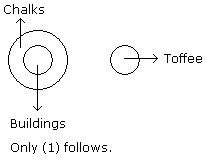
Statements: All buildings are chalks. No chalk is toffee.
Conclusions:
- No building is toffee
- All chalks are buildings.
Answer: Option
Explanation:
Discussion:
44 comments Page 4 of 5.
Sanjay vyas said:
8 years ago
The correct option is D.
Sanmaya said:
8 years ago
The correct answer is A. I agree with the given option.
Satender singh said:
8 years ago
The correct answer is D.
Madhavi said:
9 years ago
Both 1&2 follow, So, the Answer is D.
Shraddha said:
9 years ago
I think only 1 follows because all buildings are chalks but it is not clear that all chalks are building, the building is inside chalk.
Aman Anand said:
9 years ago
I think option D is correct because conclusion may be correct may not be correct but we can't say it's definitely true. So we can't say any conclusion is true. Think in this way and help me out.
Chanchal said:
10 years ago
Option A is correct because in diagram we can see cleary there is no any relation between building and toffee.
So, no building is tofee is follows.
So, no building is tofee is follows.
Sudarshan said:
10 years ago
I agree that option E is correct.
Purnendu Paul said:
10 years ago
Is there any relation (see the diagram) between toffee and buildings? No, not at all. So, conclusion: 1 is true. Now, given that, all buildings are chalks, not all chalks are buildings. So, conlusion: 2 is wrong. Therefore, Option A is right.
Pujha said:
10 years ago
Option E is correct. If all A are B, then all B is A. Or simply apply symmetry property i.e. if A = B then B = A.
Post your comments here:
Quick links
Quantitative Aptitude
Verbal (English)
Reasoning
Programming
Interview
Placement Papers