Non Verbal Reasoning - Figure Matrix - Discussion
Discussion Forum : Figure Matrix - Section 1 (Q.No. 5)
Directions to Solve
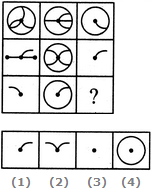
In each of the following questions, find out which of the answer figures (1), (2), (3) and (4) completes the figure matrix ?
5.
Select a suitable figure from the four alternatives that would complete the figure matrix.
Answer: Option
Explanation:
The third figure in each row comprises of the parts common to the first two figures.
Discussion:
22 comments Page 1 of 3.
Aryan Raj said:
7 months ago
Answer: (2) The figure with a dot and two curved lines.
Explanation
The pattern in the matrix follows a specific rule across each row and down each column. The third figure in each row is a combination or result of the first two figures.
Row 1: The first figure is a curved line with a dot at the end. The second figure adds a vertical line and a horizontal line crossing the dot. The third figure is a circle with two diagonal lines and two curved lines inside, combining elements or representing a transformation of the previous two figures.
Row 2: The first figure is a circle with a dot. The second figure is a circle with an 'X' shape inside. The third figure is a circle with a 'Peace' symbol inside, following a similar abstract combination or transformation logic.
Row 3: The first figure is a single dot. The second figure is a curved line with a dot at the end. To complete the pattern, the missing figure should be formed by applying the transformation rule observed in the previous rows.
The correct alternative is figure (2), which shows a dot and two curved lines. This figure fits the logical progression in the third row and column, completing the matrix.
Explanation
The pattern in the matrix follows a specific rule across each row and down each column. The third figure in each row is a combination or result of the first two figures.
Row 1: The first figure is a curved line with a dot at the end. The second figure adds a vertical line and a horizontal line crossing the dot. The third figure is a circle with two diagonal lines and two curved lines inside, combining elements or representing a transformation of the previous two figures.
Row 2: The first figure is a circle with a dot. The second figure is a circle with an 'X' shape inside. The third figure is a circle with a 'Peace' symbol inside, following a similar abstract combination or transformation logic.
Row 3: The first figure is a single dot. The second figure is a curved line with a dot at the end. To complete the pattern, the missing figure should be formed by applying the transformation rule observed in the previous rows.
The correct alternative is figure (2), which shows a dot and two curved lines. This figure fits the logical progression in the third row and column, completing the matrix.
Please enter your name. said:
1 decade ago
OK for the first figures there is something and then for the second figure there is another shape that has everything from the first shape except one thing and for the third shape you have to find that one thing that is missing;). Hope that helped all.
(1)
Prashanth said:
7 years ago
@Vidhya 2 cannot become the answer as it's consists of both a mixture of 1 & 2 and not the common thing from them. Try to find which is common to both 1&2. You will get the correct answer as an option C. Hope you can get it I think.
(2)
Name said:
1 decade ago
In each row, the first two figures don't have any pattern or relationship. But the third figure only includes the parts where the first two shapes 'overlap'.
Pavan said:
2 years ago
3 is correct because, in every row, the common element in the first picture is depicted in the third picture of the same row.
(3)
Thiago said:
1 decade ago
For that logic, answer 2 would also be correct, because it also comprises of the parts common to the first two figures.
Mukesh said:
1 decade ago
Find what is common in both figures is answer as third figure leave all that is not both figures.
The man of steel said:
1 decade ago
The answer is correct. There is nothing common in the 3rd figure matrix.
Sirisha said:
6 years ago
In the first two figures, we have to see common curves So, 3 is correct.
(1)
GAURAV said:
4 years ago
I think 1 is not correct because it is common to 2nd figure but not 1.
(2)
Post your comments here:
Quick links
Quantitative Aptitude
Verbal (English)
Reasoning
Programming
Interview
Placement Papers