Non Verbal Reasoning - Analytical Reasoning - Discussion
Discussion Forum : Analytical Reasoning - Section 1 (Q.No. 1)
1.
Find the number of triangles in the given figure.

Answer: Option
Explanation:
The figure may be labelled as shown.
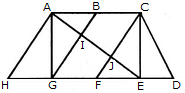
The simplest triangles are AHG, AIG, AIB, JFE, CJE and CED i.e. 6 in number.
The triangles composed of two components each are ABG, CFE, ACJ and EGI i.e. 4 in number.
The triangles composed of three components each are ACE, AGE and CFD i.e. 3 in number.
There is only one triangle i.e. AHE composed of four components.
Therefore, There are 6 + 4 + 3 + 1 = 14 triangles in the given figure.
Discussion:
55 comments Page 5 of 6.
Srini said:
1 decade ago
@Priyanka.
What are the limitation to apply this formula,
No.of total nodes + 2(no.of inner nodes).
What are the limitation to apply this formula,
No.of total nodes + 2(no.of inner nodes).
Raghu said:
1 decade ago
Is there any shortcut to find these kind of questions?
Suman sharma said:
1 decade ago
What is nodes?
Mamun Hasan said:
1 decade ago
Nodes are vertices which are labeled as (A, B, . , I, J).
Such as: A is node similarly I is an internal node.
Such as: A is node similarly I is an internal node.
Sowmya said:
1 decade ago
What is meant by nodes?
Bhuvanesh said:
1 decade ago
Nodes means intersecting points.
Ali said:
1 decade ago
Can any one explain components again?
Amrish said:
1 decade ago
What is meant by node and antinode and how should we count them?
Shalini said:
1 decade ago
There is another method to solve this problem:
1. First check the possible Triangle by Assume each node or point as (A,B,C,D,E,F,G,I,J) .
2. Second check the possibility of Joining each node i.e (AHG,ABI,AGI,AGB,AEG).
3. Then check for B and see what possible joining are available i.e(BIA,BGA).
4. Again check for C (CED,CFE,CIE,CFD) D (DEC,DFC) E (ECJ,ECF) F(FJE,FCE,FCD) G (GAE,GAI,GAB,GAH) H(HAG,HAE).
5. NOW Combine all Elements.
AHG,ABI,AGI,AGB,AEG,BIA,BGA,CED,CFE,CIE,CFD,DEC,DFC,ECJ,ECF,FJE,FCE,FCD,GAE,GAI,GAB,GAH,HAG,HAE
6. Now Eliminate same letter (AHG -> HAG)i.e remove HAG.
7. If you eliminate you will get,(AHG,ABI,AGI,AGB,AEG,BGA,CED,CFE,CIE,CFD,DFC,ECJ,FJE,HAS).
TOTALLY 14 letter are remaining..
Hope you all Understand :).
1. First check the possible Triangle by Assume each node or point as (A,B,C,D,E,F,G,I,J) .
2. Second check the possibility of Joining each node i.e (AHG,ABI,AGI,AGB,AEG).
3. Then check for B and see what possible joining are available i.e(BIA,BGA).
4. Again check for C (CED,CFE,CIE,CFD) D (DEC,DFC) E (ECJ,ECF) F(FJE,FCE,FCD) G (GAE,GAI,GAB,GAH) H(HAG,HAE).
5. NOW Combine all Elements.
AHG,ABI,AGI,AGB,AEG,BIA,BGA,CED,CFE,CIE,CFD,DEC,DFC,ECJ,ECF,FJE,FCE,FCD,GAE,GAI,GAB,GAH,HAG,HAE
6. Now Eliminate same letter (AHG -> HAG)i.e remove HAG.
7. If you eliminate you will get,(AHG,ABI,AGI,AGB,AEG,BGA,CED,CFE,CIE,CFD,DFC,ECJ,FJE,HAS).
TOTALLY 14 letter are remaining..
Hope you all Understand :).
Prasann said:
1 decade ago
Is there any process through which we can find it easily.
Post your comments here:
Quick links
Quantitative Aptitude
Verbal (English)
Reasoning
Programming
Interview
Placement Papers