Electrical Engineering - Circuit Theorems and Conversions - Discussion
Discussion Forum : Circuit Theorems and Conversions - General Questions (Q.No. 1)
1.
Find the Thevenin equivalent (VTH and RTH) between terminals A and B of the circuit given below.
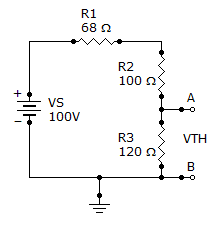
4.16 V, 120 
41.6 V, 120
4.16 V, 70
41.67 V, 70
Discussion:
43 comments Page 2 of 5.
Kusuma said:
1 decade ago
The resistances 68 and 100 are in series ; 68+100=168.
168 ohms is in parallel with 120 ohms. So,
Ith = (168*120) / (168+120) = 70 ohms.
Vth = R3* (Vs/R1+R2+R3).
Vth = 41.67V.
168 ohms is in parallel with 120 ohms. So,
Ith = (168*120) / (168+120) = 70 ohms.
Vth = R3* (Vs/R1+R2+R3).
Vth = 41.67V.
Pinvikesh said:
2 decades ago
I am not getting answer for it and I also want the simplest way to do these problems of each modle to save time please send me and also your site is useful for alot us
(2)
Christan said:
1 decade ago
Vth= VS*R3/(R1+R2+R3)
Vth= 120*100/(68+100+120)
Vth= 41.67 V
Rth= R3*(R1+R2)/(R1+R2+R3)
Rth= 120*(68+100)/(68+100+120)
Rth= 120*168/288
Rth= 20160/288
Rth= 70 Ohms
Vth= 120*100/(68+100+120)
Vth= 41.67 V
Rth= R3*(R1+R2)/(R1+R2+R3)
Rth= 120*(68+100)/(68+100+120)
Rth= 120*168/288
Rth= 20160/288
Rth= 70 Ohms
Akshit raulji said:
1 decade ago
First of all open 120 ohm resistance because Vth is find across it so it should be open than applied voltage divider rule.
Vth = 100*68/(68+100). So we get 40.47v.
Vth = 100*68/(68+100). So we get 40.47v.
Anshu said:
1 decade ago
When we have to find the venin voltage b/w two terminal then, firstly we have to remove the load resistance b/w these terminal. So why all are considering r3?
Shivendra soni said:
1 decade ago
Rth = (R1+R2)II(R3)
= (68+100)II(120)
= 70 ohm.
Vth = I (loop current)*R3
= [Vs/(R1+R2+R3)]*R3
= (100/288)*120
= 0.347*120
= 41.67V.
= (68+100)II(120)
= 70 ohm.
Vth = I (loop current)*R3
= [Vs/(R1+R2+R3)]*R3
= (100/288)*120
= 0.347*120
= 41.67V.
Swarnab Kanrar said:
2 years ago
Vth= Vs * R3/(R1+ R2 +R3)
= 100 * 120/(68+100+120)
= 41.66 V.
Rth = R3 * (R1 +R2)/(R1+ R2 +R3),
= 120 * (68+100)/(68+100+120),
= 70 ohm.
= 100 * 120/(68+100+120)
= 41.66 V.
Rth = R3 * (R1 +R2)/(R1+ R2 +R3),
= 120 * (68+100)/(68+100+120),
= 70 ohm.
(7)
EEE said:
9 years ago
@ALL.
For the kind information, R3 is opened while calculating Rth. So, actual Rth is 100+68. This is what the Venin's theorem states.
For the kind information, R3 is opened while calculating Rth. So, actual Rth is 100+68. This is what the Venin's theorem states.
RAJIV SINGH said:
10 years ago
Using voltage dider rule(vth) = 100 * 120/(60 + 100 + 120) = 41.66.
And rth = (100 + 68)/(100 + 68 + 120) = 70.
And rth = (100 + 68)/(100 + 68 + 120) = 70.
(1)
Maheshwaran said:
1 decade ago
Vth = R3*(Vs/(R1+R2+R3))= 120*(100/(68+100+120)) = 41.67 V.
Rth = R3//(R1+R2) = (120*160) / (120 + 168)= 70 ohm.
Rth = R3//(R1+R2) = (120*160) / (120 + 168)= 70 ohm.
Post your comments here:
Quick links
Quantitative Aptitude
Verbal (English)
Reasoning
Programming
Interview
Placement Papers