Electrical Engineering - Circuit Theorems and Conversions - Discussion
Discussion Forum : Circuit Theorems and Conversions - General Questions (Q.No. 1)
1.
Find the Thevenin equivalent (VTH and RTH) between terminals A and B of the circuit given below.
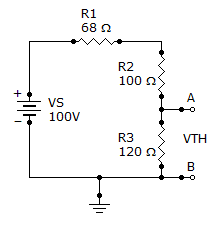
4.16 V, 120 
41.6 V, 120
4.16 V, 70
41.67 V, 70
Discussion:
43 comments Page 2 of 5.
BASAVARAJ K T said:
1 decade ago
vth=(VS*R3)/(R1+R2+R3)
Rth=R1R2/(R1+R2)
Rth=R1R2/(R1+R2)
Christan said:
1 decade ago
Vth= VS*R3/(R1+R2+R3)
Vth= 120*100/(68+100+120)
Vth= 41.67 V
Rth= R3*(R1+R2)/(R1+R2+R3)
Rth= 120*(68+100)/(68+100+120)
Rth= 120*168/288
Rth= 20160/288
Rth= 70 Ohms
Vth= 120*100/(68+100+120)
Vth= 41.67 V
Rth= R3*(R1+R2)/(R1+R2+R3)
Rth= 120*(68+100)/(68+100+120)
Rth= 120*168/288
Rth= 20160/288
Rth= 70 Ohms
Kusuma said:
1 decade ago
The resistances 68 and 100 are in series ; 68+100=168.
168 ohms is in parallel with 120 ohms. So,
Ith = (168*120) / (168+120) = 70 ohms.
Vth = R3* (Vs/R1+R2+R3).
Vth = 41.67V.
168 ohms is in parallel with 120 ohms. So,
Ith = (168*120) / (168+120) = 70 ohms.
Vth = R3* (Vs/R1+R2+R3).
Vth = 41.67V.
Loukya said:
1 decade ago
vs=R3*V/(R1+R2+R3)
Vs=46.7
Rth=R3(R1+R2)/R1+R2+R3
Rth=70
Vs=46.7
Rth=R3(R1+R2)/R1+R2+R3
Rth=70
Shivendra soni said:
1 decade ago
Rth = (R1+R2)II(R3)
= (68+100)II(120)
= 70 ohm.
Vth = I (loop current)*R3
= [Vs/(R1+R2+R3)]*R3
= (100/288)*120
= 0.347*120
= 41.67V.
= (68+100)II(120)
= 70 ohm.
Vth = I (loop current)*R3
= [Vs/(R1+R2+R3)]*R3
= (100/288)*120
= 0.347*120
= 41.67V.
Smritimoy said:
1 decade ago
RTH = 68 + 100 = 168 ohm.
VTH = 100 v.
VTH = 100 v.
Saleem shah said:
1 decade ago
Rth = R3(R1+R2)/(R1+R2+R3).
Rth = 120(68+100)/(68+100+120).
Rth = 120*168/288.
Rth = 20160/288.
Rth = 70 ohm.
Vth = Vs*R3/(R1+R2+R3).
Vth = 100*120/68+100+120.
Vth = 12000/288.
Vth = 41.6 v.
Rth = 120(68+100)/(68+100+120).
Rth = 120*168/288.
Rth = 20160/288.
Rth = 70 ohm.
Vth = Vs*R3/(R1+R2+R3).
Vth = 100*120/68+100+120.
Vth = 12000/288.
Vth = 41.6 v.
Prafull gadekar said:
1 decade ago
Total Resistance,
Rt=R1+R2+R3=120+68+100 = 288ohm.
I = V/R = 100/288 = 0.347A(flowing same current in all resistance).
Now, we want to find voltage across R3=120 ohm.
V = 120*0.347 = 41.67V
Now, Rth = R3//(R1+R2) = 70 ohm.
Rt=R1+R2+R3=120+68+100 = 288ohm.
I = V/R = 100/288 = 0.347A(flowing same current in all resistance).
Now, we want to find voltage across R3=120 ohm.
V = 120*0.347 = 41.67V
Now, Rth = R3//(R1+R2) = 70 ohm.
(1)
Keerthana said:
1 decade ago
1. Find Open Circuit Voltage(Vth):
Req = 68+100+120 = 288v.
Ieq = V/Req = 100/288 = .34722 A.
Voc =100-(68*.344722)-(100*.34722).
We get Vth = Voc = 41.667v.
Isc = 100/(68+100)= 0.5952A.
Rth = Vth/Isc.
Rth = 41.667/.5952 = 70 ohm.
Req = 68+100+120 = 288v.
Ieq = V/Req = 100/288 = .34722 A.
Voc =100-(68*.344722)-(100*.34722).
We get Vth = Voc = 41.667v.
Isc = 100/(68+100)= 0.5952A.
Rth = Vth/Isc.
Rth = 41.667/.5952 = 70 ohm.
(1)
Anirban Sengupta said:
1 decade ago
Sorry, but I am not convinced with the explanation. Whenever we will find Rth, then we have to remove the load resistance completely and then we will find the Rth. Load resistance will not have any impact in it. Then please explain how Rth becomes 70?
Post your comments here:
Quick links
Quantitative Aptitude
Verbal (English)
Reasoning
Programming
Interview
Placement Papers