Civil Engineering - Highway Engineering - Discussion
Discussion Forum : Highway Engineering - Section 5 (Q.No. 21)
21.
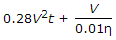
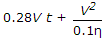
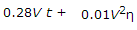
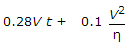
If V is the velocity in km.p.h., t the brake reaction time in seconds and η the efficiency of the brakes, the stopping distance S of the vehicle, is
Discussion:
15 comments Page 1 of 2.
Anango Mohan Chatterjee said:
8 years ago
It should be 0.28 vt + 0.01v^2/n.
(2)
Anomies said:
8 years ago
According to me, it is 0.28vt+0.01v2/n.
(1)
Harsh Shukla said:
8 years ago
SSD = vt + v^2/2 * g * (f+0.01n) {all in meter and second}.
f=n*f(actual).
If you convert it to kmph, you will be getting your answer as C so it's correct.
f=n*f(actual).
If you convert it to kmph, you will be getting your answer as C so it's correct.
(1)
Pawan said:
7 years ago
It should be 0.28vt+0. 01v^2/n.
(1)
Binod said:
5 years ago
Here SSD = 0.278Vt + V^2/(254 * 0.35 * n) = 0.278Vt + 0.01V^2/n.
(1)
Chhaya said:
9 years ago
I think option C is wrong because If n in multiplication efficiency decrease of a break then stopping distance also decrease and it is not possible.
Vikas said:
9 years ago
I think the correct option is D.
Aadil said:
9 years ago
D is the correct option. It's actually Stopping (non-passing or non-overtaking) sight distance.
Priyanshu said:
9 years ago
All are wrong.
It is 0.28vt+0. 01v^2/n.
It is 0.28vt+0. 01v^2/n.
Murali said:
9 years ago
No, option C is correct. When brake efficiency is high then stopping distance increases.
Post your comments here:
Quick links
Quantitative Aptitude
Verbal (English)
Reasoning
Programming
Interview
Placement Papers