Verbal Reasoning - Syllogism - Discussion
Discussion Forum : Syllogism - Syllogism 1 (Q.No. 1)
Directions to Solve
In each of the following questions two statements are given and these statements are followed by two conclusions numbered (1) and (2). You have to take the given two statements to be true even if they seem to be at variance from commonly known facts. Read the conclusions and then decide which of the given conclusions logically follows from the two given statements, disregarding commonly known facts.
Give answer:
- (A) If only (1) conclusion follows
- (B) If only (2) conclusion follows
- (C) If either (1) or (2) follows
- (D) If neither (1) nor (2) follows and
- (E) If both (1) and (2) follow.
1.
Statements: Some actors are singers. All the singers are dancers.
Conclusions:
- Some actors are dancers.
- No singer is actor.
Answer: Option
Explanation:
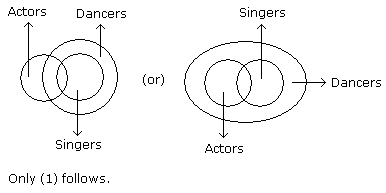
Discussion:
78 comments Page 4 of 8.
Manasa said:
1 decade ago
How to solve syllogism questions?
Kalpa said:
1 decade ago
Reasoning is the best way to solve than any tricks. Read the question twice to get the answer.
Prakash singh said:
1 decade ago
Very easy some actors are singers and all singers are dancer.
Seema said:
1 decade ago
You have study logic first. Can you solve mathematical problems without knowing formulas. There's no short cut.
Kiran said:
1 decade ago
There should be common term present between two conclusions in case if conclusion contains NO.
Then the only answer will be either or option.
Eg- all men's are a duck.
NO men are duck.
If I'm wrong correct me.
Then the only answer will be either or option.
Eg- all men's are a duck.
NO men are duck.
If I'm wrong correct me.
RICHA said:
1 decade ago
What with negative statements?
Pavi said:
1 decade ago
All squares are circles.
All circles are units.
No circle is a meter.
Conclusions:.
I. Some units which are not circles can be meters.
II. Some squares being meters is a possibility.
(Anyone please explain how to solve this using formula table).
All circles are units.
No circle is a meter.
Conclusions:.
I. Some units which are not circles can be meters.
II. Some squares being meters is a possibility.
(Anyone please explain how to solve this using formula table).
Faraz said:
1 decade ago
Hello All,
This is only for those who are very poor to understand syllogism. I assure you can understand very well through my given examples.
Here already discussed that.
*. ALL+ALL = ALL.
Means Suppose All Pens are chair & ALL chairs are tables.
It means that both the statements have all in First.
So, this can be written as All pens are tables.
Hope you understand well.
This is only for those who are very poor to understand syllogism. I assure you can understand very well through my given examples.
Here already discussed that.
*. ALL+ALL = ALL.
Means Suppose All Pens are chair & ALL chairs are tables.
It means that both the statements have all in First.
So, this can be written as All pens are tables.
Hope you understand well.
Dipesh said:
10 years ago
Please, anybody can explain this clearly? I am confused.
Anu said:
2 months ago
I think A is the correct answer.
Post your comments here:
Quick links
Quantitative Aptitude
Verbal (English)
Reasoning
Programming
Interview
Placement Papers