Verbal Reasoning - Syllogism - Discussion
Discussion Forum : Syllogism - Syllogism 1 (Q.No. 1)
Directions to Solve
In each of the following questions two statements are given and these statements are followed by two conclusions numbered (1) and (2). You have to take the given two statements to be true even if they seem to be at variance from commonly known facts. Read the conclusions and then decide which of the given conclusions logically follows from the two given statements, disregarding commonly known facts.
Give answer:
- (A) If only (1) conclusion follows
- (B) If only (2) conclusion follows
- (C) If either (1) or (2) follows
- (D) If neither (1) nor (2) follows and
- (E) If both (1) and (2) follow.
1.
Statements: Some actors are singers. All the singers are dancers.
Conclusions:
- Some actors are dancers.
- No singer is actor.
Answer: Option
Explanation:
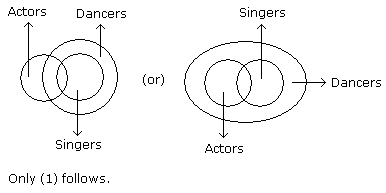
Discussion:
78 comments Page 2 of 8.
Huraira said:
9 years ago
@SUMAN
you repeated
B+A = Y.
B +B = no conclusion.
B+Z = Y.
B+Y= no conclusion.
B+A = Z.
B +B = Y.
B+Z = no conclusion.
B+Y= no conclusion.
Which combination is now correct?
you repeated
B+A = Y.
B +B = no conclusion.
B+Z = Y.
B+Y= no conclusion.
B+A = Z.
B +B = Y.
B+Z = no conclusion.
B+Y= no conclusion.
Which combination is now correct?
(3)
Ravi kumar said:
9 years ago
2nd Venn diagram shows that all actors are dancers. Then, why option A is correct?
(2)
Sejal Gautam said:
10 months ago
I think the right answer is E.
(2)
Kamal said:
9 years ago
Hi,
Can anyone explain it in short? Because I couldn't get the "some are not " model.
Statements:
All squares are circles.
All circles are units.
No circle is a meter.
Conclusions:
I. Some units which are not circles can be meters.
II. Some squares being meters is a possibility.
Anyone, please explain how to solve this using formula table.
Can anyone explain it in short? Because I couldn't get the "some are not " model.
Statements:
All squares are circles.
All circles are units.
No circle is a meter.
Conclusions:
I. Some units which are not circles can be meters.
II. Some squares being meters is a possibility.
Anyone, please explain how to solve this using formula table.
(2)
Roshan said:
10 years ago
In second diagram. All actors are dancer comes out. And in first some actors are dancers. If the statement is not satisfying both the diagrams, then how we can say one is correct?
Please explain.
Please explain.
(1)
Rahul kumar said:
1 decade ago
Statements:
All squares are circles.
All circles are units.
No circle is a meter.
Conclusions:
I. Some units which are not circles can be meters.
II. Some squares being meters is a possibility.
Anyone please explain how to solve this using formula table.
All squares are circles.
All circles are units.
No circle is a meter.
Conclusions:
I. Some units which are not circles can be meters.
II. Some squares being meters is a possibility.
Anyone please explain how to solve this using formula table.
(1)
Vidhya said:
10 years ago
Please explain the UP-UN METHOD in detail.
(1)
Tapan said:
2 decades ago
Hello friends I have a short technique,
In here no need to draw diagram. If two statement is given then 1st look the mediator if it contain ALL, NO then close ur eyes and sure that it is distributiv if the mediator have no ALL, No then the conclusion has a -ve term.
Let eg
some actor are dancer
all dancer are singer
ANS; some actor are singer/some singer are actor
some actor are dancer
some dancer are singer
ANS; some singer are not dancer
In here no need to draw diagram. If two statement is given then 1st look the mediator if it contain ALL, NO then close ur eyes and sure that it is distributiv if the mediator have no ALL, No then the conclusion has a -ve term.
Let eg
some actor are dancer
all dancer are singer
ANS; some actor are singer/some singer are actor
some actor are dancer
some dancer are singer
ANS; some singer are not dancer
(1)
Nenawat Chinari said:
7 months ago
Option : A is the correct answer.
(1)
Jacynta Moki said:
6 months ago
(A) If only (1) conclusion follows → Conclusion 1 = true, Conclusion 2 = false.
(B) If only (2) conclusion follows → Conclusion 1 = false, Conclusion 2 = true.
(C) If either (1) or (2) follows → Only one is true (not both).
(D) If neither (1) nor (2) follows → Conclusion 1 = false, Conclusion 2 = false.
(E) If both (1) and (2) follow → Conclusion 1 = true, Conclusion 2 = true.
So, A is the correct answer.
(B) If only (2) conclusion follows → Conclusion 1 = false, Conclusion 2 = true.
(C) If either (1) or (2) follows → Only one is true (not both).
(D) If neither (1) nor (2) follows → Conclusion 1 = false, Conclusion 2 = false.
(E) If both (1) and (2) follow → Conclusion 1 = true, Conclusion 2 = true.
So, A is the correct answer.
(1)
Post your comments here:
Quick links
Quantitative Aptitude
Verbal (English)
Reasoning
Programming
Interview
Placement Papers